

At the start of October, BT put a number on a problem most small-business owners already feel in their stomach. Launching its own AI receptionist, the telecoms group estimated that unanswered calls cost British firms in the region of £3.7 billion a year — roughly €4.3 billion — and that two in three of the companies it polled miss at least one call on an ordinary day that they believe cost them work (Telecoms Tech News).
It is BT’s own estimate, built on a survey, and like most figures that arrive alongside a product launch it deserves a pinch of salt. But the thing it points at is hard to dispute. For a plumber, a dental practice, a letting agent or a small law firm, the telephone is still the front door. When nobody answers it, the visitor rarely knocks twice.
Callers don’t wait, and they don’t call back
The uncomfortable truth is that a missed call is seldom a delayed sale. It is usually a sale that walks straight to a competitor. People calling a business are, by definition, ready to act, and they have the next name on the search page already open in another tab.
Speed, in other words, is the whole game. A much-cited study in the Harvard Business Review found that firms which reach a new lead within an hour are about seven times more likely to have a meaningful conversation with a decision-maker than those that wait just sixty minutes longer — and sixty times more likely than those that leave it a day .
An hour, not a day. A call that rings out at lunchtime, or after six, or during the Saturday-morning rush, is often gone for good — and voicemail does little to save it, because almost nobody leaves one any more.
What answering actually costs
The traditional fix is to hire someone to pick up, and that is where the maths turns against a small business.
A receptionist’s salary is only the visible part of the bill. According to Eurostat, non-wage costs — employer social security, holiday pay, insurance and the rest — make up about a quarter of total labour costs across the EU, and over 30% in countries such as France.
Added on top of a salary, that lifts the real cost by roughly a third. In the Netherlands, where a receptionist earns around €39,000 a year (Nationale Beroepengids), that pushes the true cost close to €50,000. In Spain, where salaries sit lower, at roughly €18,000–€24,000 gross (Paylab), the loaded figure still lands near €24,000–€32,000.
And for all that, you have bought roughly forty hours of cover a week from a single person. Evenings, weekends, bank holidays, the lunch break, sick days and the summer fortnight away all go unanswered — which is to say, the hours when a good share of calls actually arrive.
Where an AI receptionist fits
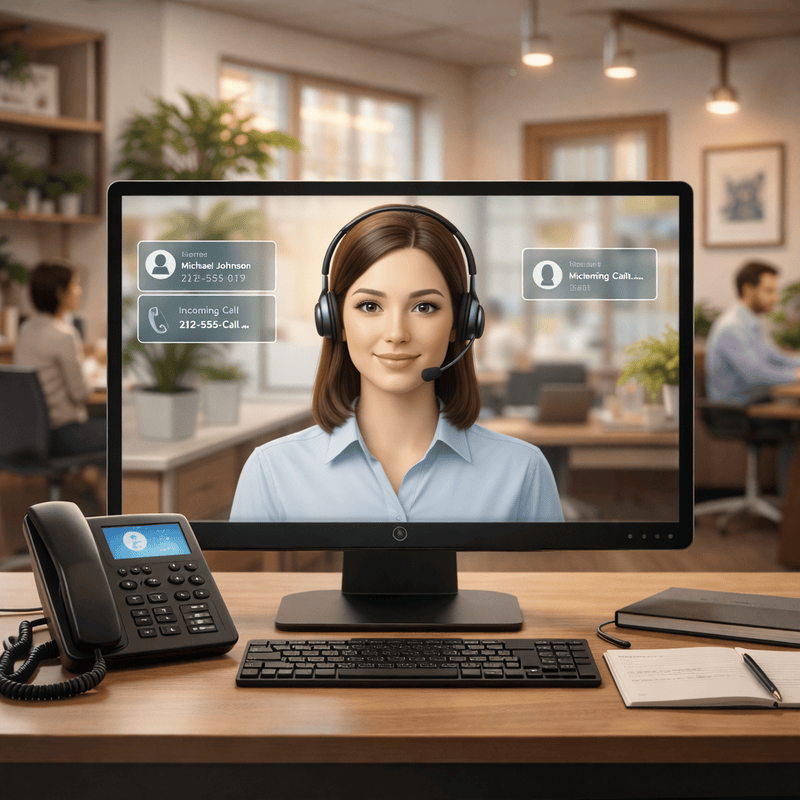
This is the gap Voixana is built for. Rather than a salaried desk that covers part of the week, it answers every call on the first ring, day and night, in the languages your customers speak, and it keeps a record of each conversation with a written summary so nothing quietly disappears.
The difference in cost is not subtle. Voixana’s plans look like this:
| Plan | Monthly | Yearly | Minutes included |
|---|---|---|---|
| Starter | €24 | €240 (€20/mo) | 150 |
| Growth | €140 | €1,440 (€120/mo) | 1,000 |
| Pro | €480 | €4,800 (€400/mo) | 4,000 |
Prices exclude VAT; annual billing lowers the monthly rate (see the yearly column). Extra minutes beyond your plan are €0.35 each, and every account starts with a free 30-minute trial (no card required).
To put that in perspective: a year of the Growth plan comes to under €1,700 even at the monthly rate — less than a fortnight of a receptionist’s loaded salary — and answers calls around the clock rather than nine to five. A small shop or sole trader on the Starter plan pays roughly €240 a year for a line that is never engaged and never off sick.
None of this makes a human receptionist worthless; a warm regular who knows every client by name is a genuine asset, and no software replaces that. But for the ordinary problem of a phone ringing while you are already busy, up a ladder, or closed for the night, the economics now point firmly in one direction. The cheapest call your business can take is the one it was about to miss.
Frequently asked questions
How much does an AI receptionist cost compared with hiring someone?
A full-time receptionist in the EU costs roughly €24,000–€50,000 a year once employer social-security and holiday costs are added, for about 40 hours of weekly cover. Voixana starts at €24 a month (€20 on annual billing) and answers calls 24/7.
Can an AI receptionist really replace a human one?
For answering, screening and routing calls, and never missing one, yes. A trusted person who knows every client by name is still valuable for relationship work; the two are not mutually exclusive.
What happens to calls outside office hours?
They are answered. Voixana picks up evenings, weekends and holidays, when a large share of calls arrive and most callers will not leave a voicemail.
Is there a free trial?
Yes — 30 minutes free, with no card required, so you can judge it on your own calls.
Sources
- Telecoms Tech News — BT Business launches AI Receptionist for customer calls
- Harvard Business Review — The Short Life of Online Sales Leads
- Eurostat — Hourly labour costs and the share of non-wage costs in the EU, 2024
- Nationale Beroepengids — Salaris Receptionist (Netherlands)
Voixana prices exclude VAT and reflect the published plans at the time of writing; see voixana.com for current pricing. The £3.7bn figure is BT’s own survey-based estimate, converted to euros for reference.